
10 Common AI Prompt Mistakes and How to Fix Them
Diagnose it from the replyStart with what came back. The symptom points to the mistake.What the reply looks likeLikely mistakeFixGeneric, co...
One is a sentence. The other is a system.

Prompt writing Brief the model like a colleague. Read the reply. Done. | Prompt engineering Build the prompt like a function. Inputs, outputs, tests. |

Same keyboard, different job.
Prompt writing Composing one clear request to get one good result, now. Success is judged by reading the reply. | Prompt engineering Designing, testing and maintaining prompts that return the right result every time, at scale. Success is judged by a pass rate on a test set. |
| Writing is a skill. Engineering is a process. |
• Most “prompt engineering” advice online is prompt writing advice. Useful, but it stops at one good reply.
• The two need different tools. A chat window versus an API, test data and version control.
• They end at different points. Writing ends when the reply looks right; engineering ends when the numbers hold.
• They are hired differently. One is a skill every knowledge worker needs; the other is a role on a product team.
Prompt writing is the everyday craft of asking well. The prompt is disposable; the reply is what you keep.

One task, one prompt, one reply. Photo: Unsplash
1 Decide the outcome What does “good” look like? | 2 Write the prompt Role, task, context, format, constraints. | 3 Read the reply Check against your outcome. | 4 Adjust or stop Tighten one thing, or accept. |
| Who | Anyone in a chat window |
| Unit of work | One prompt, one conversation |
| Inputs | Typed by you |
| Judged by | Does this reply look right? |
| Lifespan | Minutes |
• Role: who the model should act as. Sets vocabulary and judgement.
• Task: the verb and the object. “Rewrite this”, not “help with this”.
• Context: audience, source material, background. The model cannot guess it.
• Format: length, structure, output type. Prevents the wall of text.
• Constraints: what to keep, what to avoid. Saves a second round.
The University of Wisconsin's prompt writing guide breaks these components down with examples.
Example
You are a travel editor. Rewrite this 300-word hotel description for a luxury audience. Keep the rooftop bar and the pool. Under 120 words. No exclamation marks. [description pasted here] |
• The task runs once.
• You will edit the output anyway.
• You are the only user.
Six everyday jobs where a well-written prompt is the whole solution.
Drafting an email Turn bullet points into a polite, complete message. Write a 5-sentence email declining the March slot, offering April 8 or 15, warm but brief. Why writing is enough: you read every word before sending. | Rewriting for a new audience Same facts, different reader. Rewrite this product page for first-time buyers. Grade 8 reading level. Keep every spec. Why writing is enough: one page, one pass, one editor. |
Summarizing a document you pasted Long report in, short brief out. Summarize this 12-page report in 5 bullets for the CFO. Lead with cost impact. Why writing is enough: you know the source and can spot a miss. | Brainstorming options Volume first, judgement after. Give me 20 headline options for this article. Half questions, half statements. Under 9 words. Why writing is enough: you are the filter. |
Explaining a concept Learning at the level you choose. Explain vector embeddings to a marketing manager. One analogy, no maths, 150 words. Why writing is enough: the only reader is you. | Changing tone Formal to casual, or back again. Make this Slack message sound less blunt. Keep the deadline. Do not add apologies. Why writing is enough: a 30-second check catches any drift. |
Prompt engineering starts where the person typing leaves the room. The prompt is the product; the replies are its output.
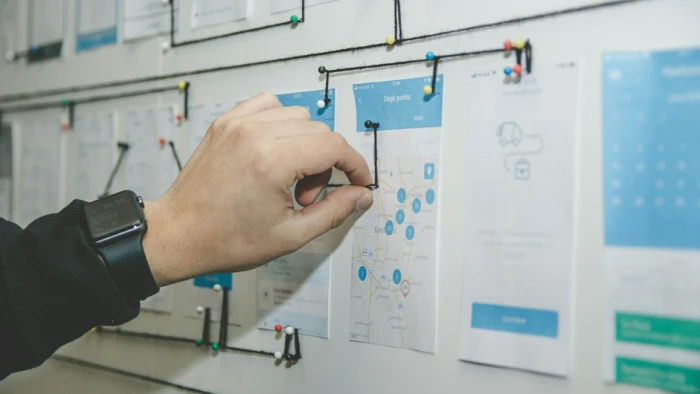
A template, a test set and a pass rate. Photo: Unsplash
1 Define I/O What comes in, what must come out. | 2 Build the template Instructions, variables, examples, schema. | 3 Collect a test set Real inputs with agreed answers. |
4 Run evals Score every output automatically. | 5 Ship a version Tag it, log it. | 6 Monitor, iterate Failures feed the test set. |
| Who | Developers, product teams, anyone shipping a prompt inside software |
| Unit of work | A prompt template plus a test set |
| Inputs | Supplied by users or other systems |
| Judged by | Pass rate on evaluations |
| Lifespan | Months, versioned |
Example
# system prompt v1.3 You extract themes from customer reviews. Return only JSON matching the schema below. No prose. Schema: {"themes":[{"name":str,"count":int,"evidence":str}]} Rules: exactly 3 themes, evidence is a verbatim quote under 20 words. <examples> [3 input/output pairs] </examples> Reviews: {{reviews}} # eval: 200 batches, target theme match >= 90%, valid JSON 100% |
• The prompt runs unattended.
• Inputs come from people who never see the prompt.
• A wrong output costs money or trust.
Six production jobs where the prompt runs thousands of times without a human reading each reply.
Support ticket triage Classify incoming tickets by category and urgency. Input: ticket text → Output: {category, priority, needs_human} Eval: 500 labelled tickets, accuracy ≥ 95% Why engineering: a misrouted ticket is a lost customer. | Invoice field extraction Pull vendor, date, total and line items into a database. Input: OCR text → Output: strict JSON schema Eval: exact-match on 300 invoices, valid JSON 100% Why engineering: one bad number breaks accounting. |
Review summarization pipeline Nightly themes from every product's reviews. Input: 50 reviews per batch → Output: 3 themes Eval: theme match ≥ 90% against analyst labels Why engineering: nobody reads 40,000 reviews to check. | Content moderation Flag policy violations before publication. Input: post text → Output: allow / flag / block + reason Eval: false-negative rate on 1,000 known cases Why engineering: errors carry legal and brand risk. |
Code or SQL generation in a product Natural-language questions to runnable queries. Input: question + schema → Output: SQL only Eval: query executes and returns expected rows Why engineering: the output is executed, not read. | Answers over company documents Retrieval-augmented assistant for staff or customers. Input: question + passages → Output: cited answer Eval: groundedness and citation accuracy on 400 questions Why engineering: a confident wrong answer is worse than none. |
Most work sits between the two. Move right as the number of users, runs and consequences grows.
| Prompt writing | Prompt engineering | |||
One-off email One user, one run | Weekly report template One user, 50 runs a year | Team tool 10 users, hundreds of runs, someone checks | Customer-facing feature Thousands of runs, nobody checks | Autonomous agent Chained prompts, real actions |
| Dimension | Prompt writing | Prompt engineering |
|---|---|---|
| Goal | One good output | Reliable outputs at scale |
| Unit of work | A prompt | A template plus a test set |
| Inputs | You type them | Users or systems supply them |
| Success measure | Looks right to you | Pass rate on evals |
| Iteration | Reply and retry | Change, re-run, compare versions |
| Tools | Chat window | API, eval scripts, version control |
| Techniques | Role, task, context, format, constraints | All of those, plus few-shot, chain-of-thought, structured output, guardrails |
| Failure cost | A minute of your time | Money, trust, or a broken pipeline |
| Lifespan | Minutes | Months |
| Who | Anyone | Developers and product teams |
Task: turn 50 customer reviews into three themes.

Engineering ends with a number, not a feeling. Photo: Unsplash
The writing approach 1. Paste the reviews. 2. Type: “Summarize these into three themes with one quote each.” 3. Read the reply. Looks good. Done. Time: 2 minutes. Works: today. | The engineering approach 1. Template with a {{reviews}} variable and a JSON schema. 2. Three worked examples. 3. 200 review batches with agreed themes. 4. Run, score: theme match 91%, valid JSON 100%. 5. Ship v1.3, log failures, re-run monthly. Time: 2 days. Works: next month, on reviews nobody has read. |
Shipping a chat prompt It worked once, on your input. That is not evidence. | Testing on one example A test set needs the ugly inputs, not the clean one. |
Calling a role line “engineering” “You are an expert” is writing. A pass rate is engineering. | Skipping examples when format matters Two demonstrations beat a paragraph of rules. |
Over-engineering a one-off Two days of evals for an email you will send once. | Never re-running Models update. Yesterday’s 91% is not today’s. |

Every engineer writes prompts; not every writer engineers them. Photo: Unsplash
• Both need a clear task, the right context and at least one example.
• Both improve by iteration.
• Both fail the same way: ambiguity in, ambiguity out.
• Good writers learn engineering faster, but engineering is measured by evals, not prose quality, as this argument for why it is not just writing sets out.
Learn writing first. Engineer when it ships. • Writing gets one answer right. • Engineering gets the same answer right 10,000 times. • The difference is not vocabulary; it is a test set. |
Diagnose it from the replyStart with what came back. The symptom points to the mistake.What the reply looks likeLikely mistakeFixGeneric, co...

GUIDE Updated September 2026 About a 12 minute readHow to Write Better AI Image PromptsA complete, practical guide t...

Scroll far enough through any Indian feed in 2026 and the same shot keeps reappearing in variations: a familiar face, unmistakably real, sta...
Discussion
Join the discussion and share your thoughts below.
No comments yet. Be the first to share your thoughts!