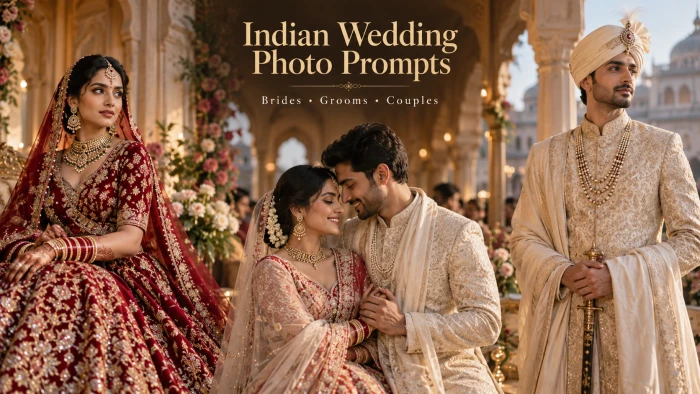
10 Indian Wedding AI Photo Prompts for Brides, Grooms and Couples
How to use these promptsEach prompt works the same way. You upload a photo, paste the prompt, and the model rebuilds the outfit, location an...
The word "cinematic" on its own tells an image model almost nothing. What makes a frame look like it came from a film is a set of specific choices about framing, lens, light, color and atmosphere. This guide teaches you the vocabulary, gives you a formula
A cinematic image is a still that reads as one frame from a larger story. Something is happening, the light comes from somewhere, the camera has a point of view, and the colors have been decided rather than left to chance.
Image models learned that look from millions of film stills, trailers, and professional photographs. When your prompt uses the same language a cinematographer would use, the model can reach for that training instead of guessing.
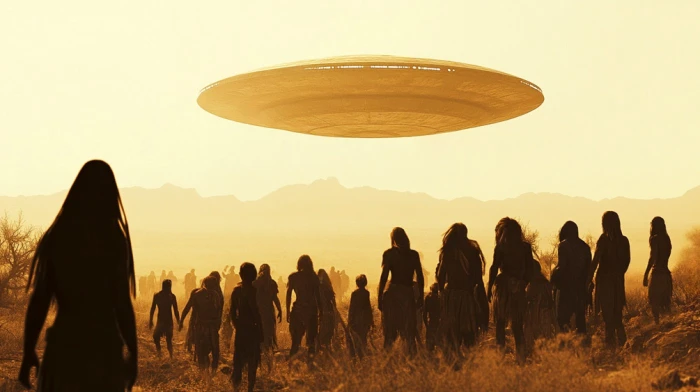
Every cinematic ingredient at once: a wide frame, a low sun behind the subjects, silhouettes, haze and a single warm palette.
Look at what the frame above does. The horizon is low, so the sky and the craft dominate. The sun sits behind the crowd, so every figure becomes a shape. Dust in the air catches the light and softens the distance. The whole image lives in one family of warm tones.
None of that came from the word "cinematic". It came from specific, describable decisions. The rest of this guide gives you the words for those decisions.
The one sentence version: a cinematic prompt describes a subject doing something, framed a certain way, through a specific lens, lit from a specific place, in a chosen color world, with air in the scene. Name each of those and almost any model will deliver.
Most working prompts follow the same order. The order matters because models weight earlier words more heavily, so the subject and action go first and the technical polish goes last.
1. SUBJECT AND ACTION Who or what, and what they are doing right now | 2. SETTING AND TIME Where the scene is and what time of day it is | 3. SHOT AND ANGLE How close the camera is and where it sits | 4. LENS AND FOCUS Focal length, aperture and depth of field |
5. LIGHTING The main light source, its direction and quality | 6. COLOR AND STOCK The grade, palette and film stock reference | 7. ATMOSPHERE AND TEXTURE Haze, particles, grain, weather | 8. FRAME AND PARAMETERS Aspect ratio and tool specific settings |
Here is the formula filled in. The image below was not made from this exact prompt, but it contains every element the prompt asks for, which is the point: describe the result you can see, and the model can build it.
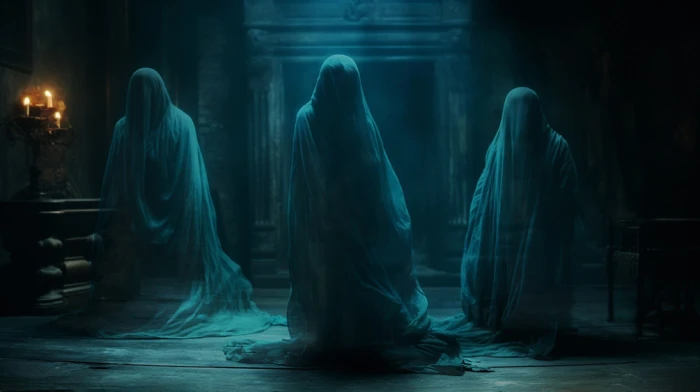
Low key lighting, a cold teal grade with warm candle practicals, haze and a wide frame.
FORMULA IN PRACTICE Three translucent draped figures kneeling in a ruined stone hall, facing a distant altar, night. Wide shot, camera at floor level looking slightly up. 24mm lens, deep focus. Single cold moonlight source from a high window, candles as warm practicals in the background. Teal and amber grade, crushed blacks, Kodak Vision3 500T look. Heavy haze, dust motes in the light shafts, fine film grain. 21:9 aspect ratio. |
Read that prompt as eight short clauses and you can see the formula at work. Swap the subject and the setting and the same skeleton produces a heist scene, a wedding, or a product shot.
These are the words that do the work. Each table gives the term, what it does to the image, and a phrase you can drop straight into a prompt.
Shot size sets the relationship between the subject and the world. Wide shots make people small and places big. Close ups make emotion big and places disappear.
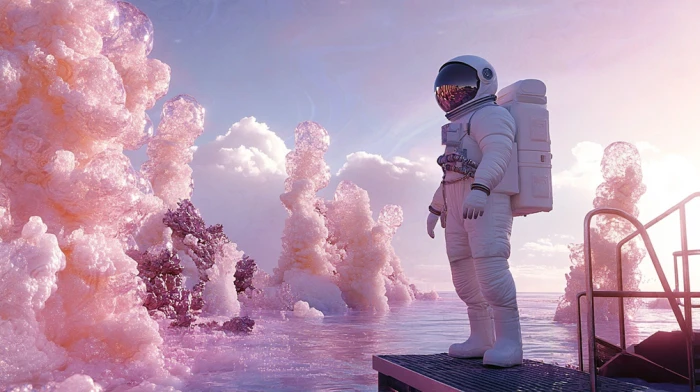
A wide shot with the subject placed off center against a vast environment. The scale contrast is the story.
| Term | What it does | Prompt phrase |
|---|---|---|
| Extreme wide shot | Establishes location and scale. The subject is tiny or absent. | extreme wide shot, lone figure dwarfed by the landscape |
| Wide shot | Shows the full body and the surroundings together. | wide shot, full body visible, environment in frame |
| Medium shot | Waist up. The default for conversation and action. | medium shot, waist up, subject centered |
| Close up | Face fills the frame. Emotion over context. | close up on the face, eyes in sharp focus |
| Extreme close up | A detail: an eye, a hand, a trigger, a ring. | extreme close up of the hands gripping the wheel |
| Over the shoulder | Frames one subject past another's shoulder. Implies a relationship. | over the shoulder shot, foreground shoulder soft |
| Two shot | Two subjects in one frame, usually medium. | two shot, both subjects in profile facing each other |
| Rule of thirds | Subject on a third line rather than dead center. | subject on the left third, negative space to the right |
| Negative space | Empty area that isolates the subject and creates mood. | large negative space above the subject |
| Leading lines | Roads, rails or light shafts that pull the eye to the subject. | leading lines of the corridor converging on the figure |
Angle decides power. A camera looking up makes the subject dominant. A camera looking down makes them vulnerable. Movement terms describe a single frozen frame that implies motion, which is useful even in a still.
| Term | What it does | Prompt phrase |
|---|---|---|
| Eye level | Neutral, documentary feel. The viewer is a peer. | camera at eye level |
| Low angle | Subject looms. Heroic, threatening or monumental. | low angle looking up at the subject |
| High angle | Subject looks small, lost or observed. | high angle looking down from a rooftop |
| Overhead or top down | Graphic, map like composition. Common for tables and streets. | overhead top down shot of the diner table |
| Dutch angle | Tilted horizon. Unease, chaos, disorientation. | dutch angle, horizon tilted 15 degrees |
| Point of view | The camera is a character's eyes. | first person point of view, hands visible at the bottom of frame |
| Dolly in | Camera physically moves toward the subject. Implies growing tension. | frame from a slow dolly in, subject sharp, background compressed |
| Tracking shot | Camera moves alongside a moving subject. | tracking shot alongside the runner, motion blur on the background |
| Crane or aerial | Sweeping high vantage, epic scale. | aerial establishing shot from a crane height |
| Handheld | Slight tilt and imperfection. Immediacy and realism. | handheld feel, slight frame tilt, natural imperfection |
Focal length changes how space feels. Wide lenses stretch distance and exaggerate foreground. Long lenses compress it and flatten the background into a soft wash. Aperture controls how much of that background stays sharp.
| Term | What it does | Prompt phrase |
|---|---|---|
| 14mm to 24mm | Ultra wide. Big environments, dramatic perspective, slight distortion at the edges. | shot on a 24mm lens, expansive perspective |
| 35mm | Natural, immersive. The workhorse for street and drama. | 35mm lens, natural perspective |
| 50mm | Close to human vision. Clean and neutral. | 50mm lens at f/1.8 |
| 85mm | Portrait compression. Flattering faces, creamy backgrounds. | 85mm portrait lens, f/1.4, shallow depth of field |
| 135mm to 200mm | Telephoto. Stacks distant objects together, isolates the subject completely. | 200mm telephoto compression, background stacked |
| Shallow depth of field | Only the subject is sharp. Draws the eye and hides clutter. | shallow depth of field, background falls into soft blur |
| Deep focus | Everything sharp from foreground to horizon. Classic for wide establishing shots. | deep focus, sharp from foreground to horizon |
| Bokeh | The shape and quality of out of focus highlights. | round creamy bokeh from distant streetlights |
| Anamorphic | Oval bokeh, horizontal flares, wide 2.39:1 frame. | anamorphic lens, horizontal blue lens flare, oval bokeh |
| Rack focus | Focus shifts from one plane to another. In a still, one plane sharp and one soft. | rack focus moment, foreground glass sharp, face soft behind it |
If you fix only one thing in a flat prompt, fix the lighting. Flat, even light is the single biggest reason an AI image looks like a stock photo. Cinematic light has a direction, a source that exists in the scene, and shadows that are allowed to stay dark.
| Term | What it does | Prompt phrase |
|---|---|---|
| Motivated light | Light that comes from a source visible or implied in the scene. | lit only by the window on the left |
| Key light | The main source. Its position defines the mood. | single key light from camera left, 45 degrees |
| Fill light | Softens the shadows the key creates. Less fill means more drama. | minimal fill, deep shadows on the right side |
| Rim or back light | Separates the subject from the background with an edge of light. | rim light outlining the hair and shoulders |
| Rembrandt lighting | Key at 45 degrees leaving a triangle of light on the shadow cheek. | Rembrandt lighting, triangle of light on the cheek |
| Low key | Dark overall with small bright areas. Noir, thriller, horror. | low key lighting, most of the frame in shadow |
| High key | Bright, airy, few shadows. Comedy, beauty, commercials. | high key lighting, soft and bright |
| Chiaroscuro | Extreme light against extreme dark, painterly. | chiaroscuro, hard light carving the figure out of darkness |
| Golden hour | Low warm sun just after sunrise or before sunset. | golden hour, long shadows, warm backlight |
| Blue hour | Cool ambient light just after sunset, with practicals glowing. | blue hour, cool sky, warm windows glowing |
| Practicals | Lamps, neon, screens or candles that appear in the frame. | neon sign practical casting magenta on the wet street |
| Volumetric light | Visible shafts of light through haze or dust. | volumetric light shafts through the dusty air |
StudioBinder's overview of film lighting techniques explains each setup with reference frames, and the Wikipedia entry on Rembrandt lighting covers the geometry.
A grade is a decision about which colors are allowed in the frame. The same scene can be graded warm and nostalgic or cold and clinical. Film stock names are shorthand for a whole package of color response, contrast and grain, and image models know them well.
The two frames below are the same photograph. The first is the camera's neutral rendering. The second has a cinematic grade applied: a letterboxed 16:9 crop, warmer highlights, cooler shadows and lifted contrast.
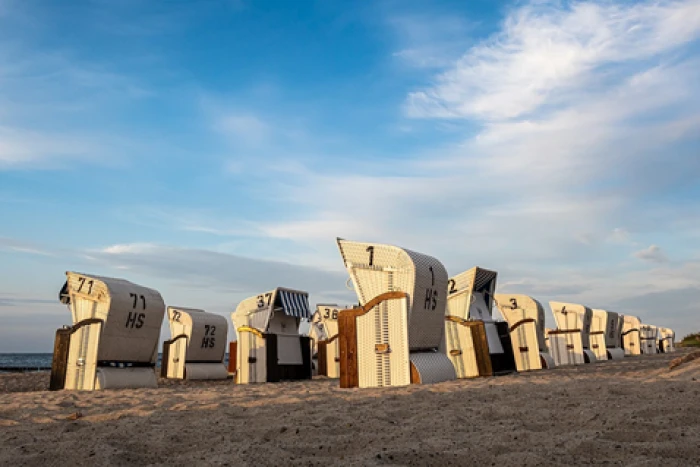 Neutral rendering. | 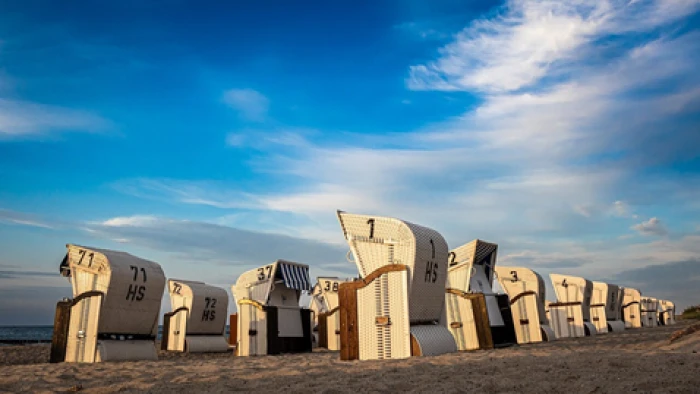 The same frame with a cinematic grade and crop. P |
| Term | What it does | Prompt phrase |
|---|---|---|
| Teal and orange | Cool shadows, warm skin and highlights. The modern blockbuster look. | teal and orange color grade |
| Desaturated | Muted colors, serious tone. War films, prestige drama. | desaturated palette, muted earth tones |
| Monochromatic | One hue in many values. Strong graphic unity. | monochromatic amber palette |
| Complementary palette | Two opposite hues for tension. Magenta and green, blue and gold. | magenta and green complementary palette |
| Crushed blacks | Shadows pushed to pure black. Dense, moody. | crushed blacks, deep contrast |
| Lifted blacks | Shadows raised to soft gray. Faded, nostalgic. | lifted blacks, faded film look |
| Kodak Vision3 500T | Tungsten balanced cinema stock. Warm interiors, subtle grain. | Kodak Vision3 500T look |
| Kodak Portra 400 | Soft skin tones, gentle pastel warmth. Portraits and daylight. | Kodak Portra 400 look |
| CineStill 800T | Night stock with red halation around bright lights. Neon streets. | CineStill 800T look, red halation around the lights |
| Fuji Eterna | Low contrast, cool greens, restrained. Quiet drama. | Fujifilm Eterna look, soft contrast |
| Kodak Double-X | Black and white cinema stock with rich mid tones. | black and white, Kodak Double-X look |
| Technicolor | Saturated, dye rich color from classic Hollywood. | three strip Technicolor look, saturated primaries |
Atmosphere is what makes air visible. Haze, dust and rain give light something to hit, which creates depth. Texture words fight the plastic smoothness that models default to. Mood words tie the whole prompt together and help the model choose between dozens of valid interpretations.
| Term | What it does | Prompt phrase |
|---|---|---|
| Haze or fog | Softens distance, separates planes, shows light beams. | light atmospheric haze, distance fading softly |
| Dust motes | Particles catching light. Intimacy and stillness. | dust motes drifting in the light shaft |
| Rain and wet surfaces | Reflections double every light source. | rain soaked street reflecting the neon |
| Smoke and steam | Movement and texture in interiors. | steam rising from the cup into the backlight |
| Film grain | Fine noise that reads as celluloid rather than digital. | subtle film grain |
| Halation | Soft glow bleeding around bright highlights. | gentle halation around the lamps |
| Chromatic aberration | Slight color fringing at the edges. Vintage lens feel. | slight chromatic aberration at the frame edges |
| Skin texture | Pores, fine lines and asymmetry that stop faces looking waxy. | natural skin texture, visible pores, slight asymmetry |
| Mood words | One or two emotional anchors for the whole image. | melancholic and quiet, or tense and expectant |
| Era cues | Period details that lock the look to a decade. | 1970s New York, sodium vapor streetlights |
Follow these in order the first few times. Once the sequence is habit, you will write a full cinematic prompt in under a minute and know exactly which clause to change when the result is off.
Ask what is happening in this exact frame and what happened one second before. A person "standing" is a stock photo. A person "turning toward the door as it opens" is a scene.
Write the subject and the action as the first clause. Keep it concrete: one subject, one verb, one object or direction.
| Example: "A night shift nurse pausing at the end of an empty hospital corridor, looking back over her shoulder." |
Decide how close the viewer is and where they stand. Wide for loneliness or scale, medium for action, close for emotion. Then set the height: low angle for power, eye level for honesty, high angle for vulnerability.
Say both explicitly. Models default to a medium shot at eye level unless told otherwise.
| Example: "Wide shot from the far end of the corridor, camera slightly low, subject on the right third." |
Match the focal length to the shot. Wide shots suit 24mm to 35mm. Portraits suit 85mm. Then decide depth of field: shallow to isolate, deep to show everything.
If you want the film look most people mean by cinematic, add "anamorphic". It changes the bokeh, the flares and the frame in one word.
| Example: "35mm anamorphic lens, deep focus so the whole corridor stays sharp." |
Name where the light comes from and what it is. A window, a fluorescent tube, a car headlight, a phone screen. One source with real shadows beats three sources with none.
Add a rim or back light only if you need the subject separated from a dark background. Then say how much fill you want, which is usually "minimal".
| Example: "Lit by flickering green fluorescent ceiling tubes, one exit sign glowing red at the far end, minimal fill, deep shadows along the walls." |
Choose a palette that matches the mood, then name a film stock that carries it. The stock reference does more work than a paragraph of color description because the model has seen thousands of frames shot on it.
Keep the palette to two hues. More than that and the image stops feeling designed.
| Example: "Sickly green and red complementary palette, Kodak Vision3 500T look, crushed blacks." |
Give the light something to hit. Haze, steam, rain or dust turns a lit set into a lit space. Then add one texture word that fights digital smoothness, usually "subtle film grain" or "natural skin texture".
Finish with one or two mood words. They do not describe anything visible, but they steer every small decision the model makes.
| Example: "Thin haze in the air, subtle film grain, tense and hushed." |
Widescreen ratios change composition more than any single word. Use 21:9 or 2.39:1 for a film frame, 16:9 for a television frame, and 4:3 or 1.85:1 for a deliberately classic feel.
Then add the tool specific settings: Midjourney parameters after the text, or a plain sentence for chat based models such as "landscape format, widescreen".
| Example: "--ar 21:9 --stylize 150 --raw" in Midjourney, or "Render in a 21:9 widescreen frame" in ChatGPT or Gemini. |
Generate four to eight images, pick the closest, and change exactly one clause. Change the lens or the light or the grade, never all three. This is the only way to learn what each word is doing in the tool you use.
When you find a look you like, save the settings that produced it: seed, style reference code or the reference image. That is how you keep a series consistent.
| Example: Pass 1 fixes the shot. Pass 2 swaps 35mm for 24mm. Pass 3 warms the exit sign from red to amber. Pass 4 adds rain on the floor. Each pass answers one question. |
THE 8 STEPS ASSEMBLED INTO ONE PROMPT A night shift nurse pausing at the end of an empty hospital corridor, looking back over her shoulder. Wide shot from the far end of the corridor, camera slightly low, subject on the right third. 35mm anamorphic lens, deep focus. Lit by flickering green fluorescent ceiling tubes, one exit sign glowing red at the far end, minimal fill, deep shadows along the walls. Sickly green and red complementary palette, Kodak Vision3 500T look, crushed blacks. Thin haze in the air, subtle film grain, tense and hushed. --ar 21:9 --stylize 150 --raw |
Each example follows the formula and targets a different genre. Copy one, swap the subject and setting, and keep the technical clauses. The "why it works" line tells you which clause carries the look so you know what not to delete.
Why it works: wet surfaces double the practical lights, and CineStill halation sells the night.
| Close up of a woman in a wet raincoat waiting under a shop awning, rain falling, night. 85mm lens, f/1.4, shallow depth of field. Lit by a magenta neon sign practical from the left and a cyan storefront from the right, no other light. Magenta and cyan palette, CineStill 800T look, red halation around the lights. Raindrops catching highlights, reflective wet pavement bokeh, subtle grain, lonely and calm. 2.39:1 |
Why it works: scale contrast plus a low sun and dust makes any figure feel mythic.
| Extreme wide shot of a lone rider on horseback crossing a dune ridge toward a distant storm, late afternoon. 24mm lens, deep focus, horizon on the lower third. Golden hour sun low behind the rider, long shadows across the sand, rim light on the dust. Warm amber and deep violet palette, Kodak Vision3 250D look. Blowing sand catching the light, fine grain, vast and quiet. 21:9 |
Why it works: one hard source through blinds and black and white stock do all the storytelling.
| Medium shot of a detective seated at a desk reading a letter, 1940s office at night. 50mm lens, moderate depth of field. Single hard key light from a window with venetian blinds casting stripes across the desk and his face, no fill, cigarette smoke in the beam. Black and white, Kodak Double-X look, deep blacks, silver highlights. Low key, chiaroscuro, suspicious and still. 1.85:1 |
Why it works: motivated backlight and steam give a static object motion and depth.
| Extreme close up of a ceramic espresso cup on a dark walnut bar, steam rising, early morning. 100mm macro lens, f/2.8, shallow depth of field on the rim of the cup. Backlit by a single low window behind the cup, steam glowing in the beam, soft reflected fill from the bar surface. Warm monochromatic amber palette, Kodak Portra 400 look. Micro texture on the ceramic, subtle grain, calm and premium. 16:9 |
Why it works: leading lines and volumetric light build depth in a hard, clean environment.
| Wide shot of an engineer walking away from camera down a long spacecraft corridor, lights activating ahead of her. 24mm anamorphic lens, deep focus, corridor lines converging on the figure. Cool white ceiling strips as the key, warm orange floor practicals every few meters, haze showing volumetric beams. Teal and orange grade, Fujifilm Eterna look, lifted blacks. Anamorphic horizontal flares, fine grain, methodical and tense. 2.39:1 |
Why it works: backlight through trees produces the light shafts that define this look.
| Wide shot of a child running along a forest path toward the camera, late summer evening. 35mm lens, f/2.8, subject sharp with the far trees softening. Golden hour sun directly behind the child, rim light on hair, long shadows across the path, sun flare at the top of frame. Warm gold and soft green palette, Kodak Portra 800 look. Pollen and dust in the light shafts, light haze, subtle grain, joyful and nostalgic. 21:9 |
Why it works: caustics and a single overhead source create a natural low key setup.
| Medium shot of a free diver suspended in open water looking up toward the surface. 20mm lens, deep focus, subject on the left third with negative space above. Sunlight from directly overhead breaking into caustic patterns, the diver half silhouetted, darkness below. Deep teal monochromatic palette, desaturated, crushed blacks. Suspended particles catching the light, subtle grain, weightless and serene. 2.39:1 |
Why it works: tracking shot language and motion blur imply movement in a still.
| Low angle tracking shot alongside a vintage muscle car sliding through a wet intersection at night. 35mm lens, car sharp, background streaked with motion blur. Sodium vapor streetlights as the key from above, headlights raking the wet asphalt, neon reflections in the puddles. Orange and teal grade, Kodak Vision3 500T look. Rain spray, tire smoke, subtle grain, urgent and loud. 21:9 |
Why it works: candle practicals and a painterly reference lock the era and the light together.
| Two shot of two women in 18th century dress speaking quietly at a long dining table, night. 50mm lens, f/2, both faces sharp, background candelabra softening. Lit only by candles on the table, warm flicker, deep shadows beyond the table edge. Amber and umber monochromatic palette, chiaroscuro in the manner of Georges de La Tour, lifted blacks. Smoke from the candles, subtle grain, intimate and secretive. 1.85:1 |
Why it works: a top down angle turns a simple table into a graphic composition.
| Overhead top down shot of a diner booth table with two coffees, a folded newspaper and a set of car keys, morning. 35mm lens, deep focus, the table filling the frame edge to edge. Hard morning sunlight from a window on the right casting long sharp shadows across the formica, no fill. Cream and faded red palette, Kodak Ektachrome look, slightly desaturated. Steam from the cups, worn table texture, subtle grain, patient and wry. 4:3 |
The vocabulary above works in every major model. What changes between tools is how literally they follow it, how you control the frame, and how you keep a look consistent across a series. These five cover the range as of mid 2026.
Best for aesthetic quality and series consistency
Midjourney remains the tool most people mean when they say an AI image looks cinematic. The V8 line arrived in early 2026 and V8.1 became the default in June. It has a natural bias toward dramatic light and pleasing composition, which is helpful for film looks and occasionally too much for literal briefs.
Parameters do the framing. Everything after the prompt text is a switch. --ar 21:9 sets the frame. --stylize runs from 0 to 1000 with 100 as the default and controls how much Midjourney adds its own taste. --raw turns that taste off for a more literal read of your lighting and lens words.
Style references keep a series consistent. --sref takes an image URL or a numeric code and copies its color, lighting and texture into new images. --sw sets the strength from 0 to 1000. Generate a look once, note the code, and reuse it across a whole campaign.
Omni reference keeps a character consistent. --oref with an image and --ow for weight lets the same person or object appear across shots, which is what you need for a storyboard.
| Access | Web app and Discord. No public API. |
| Pricing | Monthly subscriptions from about $10 per month, as of mid 2026. |
| Cinematic settings | --ar for frame, --stylize 100 to 250 for film realism, --raw for literal prompts, --sref for a shared grade, --seed to repeat a result. |
| Watch out for | Legible text in frame is still weaker than rivals. Default styling can override subtle lighting instructions unless you use --raw. |
| Documentation | Midjourney parameter list and style reference guide |
Best for conversational iteration
OpenAI's current image model runs inside ChatGPT and through the API. Its strength for cinematic work is not the first image but the fifth. You describe the frame in plain sentences, then say "make the key light warmer" or "move the camera lower" and the model edits the same scene rather than starting over.
Write in full sentences. There are no dash parameters. Aspect ratio, lens and lighting all go into the prose, and the model follows long, specific descriptions closely.
Iterate on one variable. Because the conversation keeps context, the eight step method maps directly onto a chat: one message per pass, one change per message.
Text and props are reliable. Signs, labels and screens render legibly, which matters for diner, storefront and product scenes.
| Access | ChatGPT plans and the OpenAI API. |
| Pricing | Included in ChatGPT subscriptions with usage limits. Per image pricing on the API. |
| Cinematic settings | State the aspect ratio in words, such as "widescreen 21:9 frame". Describe lens and light in sentences. Ask for edits rather than regenerating. |
| Watch out for | Extreme film grain and heavy stylization can be softened by the model's preference for clean output. Ask twice if you want it gritty. |
| Documentation | OpenAI image generation guide |
Best for photorealism and lighting physics
Google's image models, known as Nano Banana, lead most 2026 blind tests for photorealism. Materials, reflections and how light actually behaves on skin and metal are unusually convincing, which makes the model a strong fit for product and portrait work that has to pass as photography.
Reference images anchor the look. You can supply several images and ask for a new frame in the same lighting and grade, which is the fastest way to match a brand's existing photography.
Physical light words land. Terms like "rim light", "practical", "caustics" and "halation" translate accurately because the model was trained with a bias toward physically plausible output.
Free tier exists. The standard Nano Banana 2 model is available in the Gemini app at no cost, so you can test prompts before paying for the Pro tier.
| Access | Gemini app and the Gemini API through Google AI Studio. |
| Pricing | Free tier for the standard model. Pro through Google AI plans and per image on the API. |
| Cinematic settings | Describe aspect ratio in words. Attach reference frames for grade and lighting. Ask for "photographic, not illustrated" if output drifts. |
| Watch out for | Very stylized or painterly looks are less its strength. For noir grain and heavy grades, Midjourney is more willing. |
| Documentation | Gemini API image generation docs |
Best for control, pipelines and self hosting
FLUX is the model family that inherited the open weights community that used to gather around Stable Diffusion. FLUX.2 ships in hosted and downloadable variants, so you can run it through an API, inside a node based tool, or on your own hardware with custom fine tunes.
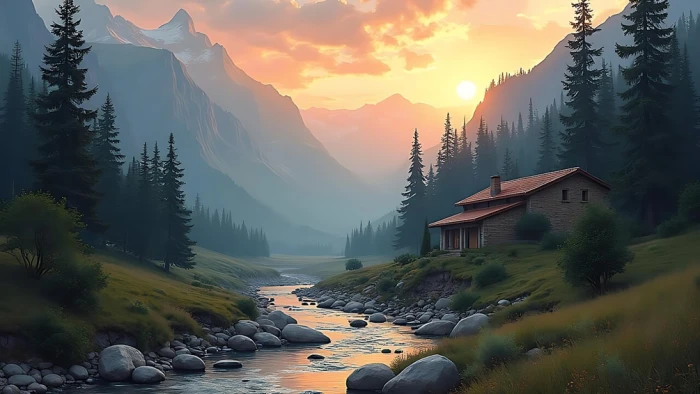
A golden hour valley generated with the earlier FLUX.1 model.
Literal by default. FLUX follows structured prompts closely and does not add much of its own taste. The eight clause formula reads cleanly, and the official prompting guide recommends exactly this kind of ordered, specific description.
Multi reference and exact color. FLUX.2 accepts several reference images and can hold specific color values, which suits brand work where the grade has to match a style guide.
Trainable. With the open variants you can train a small adapter on a set of frames from your own project and get a repeatable house look that no prompt could describe.
| Access | Black Forest Labs API, third party platforms, and downloadable weights for local use. |
| Pricing | Per image on the API. Free to run locally if you have the hardware, subject to the model license. |
| Cinematic settings | Set width and height directly for exact ratios. Use structured prompts in the formula order. Add reference images for grade and character. |
| Watch out for | Local setup takes technical effort. Hosted variants differ in quality and cost, so check which one a platform actually runs. |
| Documentation | FLUX.2 prompting guide |
Best for commercially safe client work
Firefly is the model Adobe trained on licensed and public domain content, and it is the one with a clear commercial indemnification story. Since late 2025 the Firefly app has also become a hub that hosts partner models, so you can run a Firefly prompt beside other engines and finish in Photoshop.
Style and structure references. Upload a frame as a style reference to copy its grade and lighting, or as a structure reference to copy its composition while changing everything else.
Built in cinematic controls. The interface exposes lighting, color and camera options as menus, which mirror the glossary above and are a good way to learn what each term does.
Finishing inside Creative Cloud. Generative fill, expand and Photoshop grading tools are one click away, which matters when a client wants the frame slightly wider or the sky slightly warmer.
| Access | Firefly web app, Photoshop, Illustrator and Express. |
| Pricing | Individual plans from about $10 per month, bundled credits in Creative Cloud plans, as of mid 2026. |
| Cinematic settings | Choose the aspect ratio from the panel. Use the lighting and camera menus plus prose. Attach a style reference for a consistent grade. |
| Watch out for | Raw aesthetic ceiling sits below Midjourney for moody, grainy looks. Named film stocks and living artists are filtered more strictly. |
| Documentation | Adobe Firefly |
| Which to pick: Midjourney for the strongest film look and series consistency, GPT Image 2 for talking your way to the frame, Nano Banana Pro for photoreal light and materials, FLUX.2 for pipelines and custom training, Firefly for client work that needs legal cover. Many professionals keep two of these and use the same prompt vocabulary in both. |
The table below shows the same twelve decisions written the way most people write them, and the way a cinematographer would. Reading down the third column is a fast way to audit any prompt you already have.
| Element | Standard prompt | Cinematic prompt | Why it matters |
|---|---|---|---|
| Subject | A woman in a city | A courier checking a cracked phone screen under an awning | Action and detail imply a story and a moment |
| Framing | Not specified | Medium close up, subject on the right third | Unspecified framing defaults to a centered medium shot |
| Angle | Not specified | Camera slightly below eye level | Angle sets the power relationship with the viewer |
| Lens | Not specified | 85mm at f/1.4 | Focal length and aperture define compression and blur |
| Light source | Dramatic lighting | Lit only by a magenta neon sign to the left | Motivated light produces believable shadows |
| Shadows | Not specified | Minimal fill, deep shadows on the right side | Shadow is where the mood lives |
| Color | Colorful | Magenta and cyan complementary palette | Two hue palettes read as designed |
| Stock | Not specified | CineStill 800T look with halation | A stock name carries contrast, grain and color response |
| Atmosphere | Not specified | Light rain, wet pavement reflections, thin haze | Air and water give light something to hit |
| Texture | 8K ultra HD | Natural skin texture, subtle film grain | Resolution words add polish, texture words add realism |
| Aspect ratio | Default square | 2.39:1 widescreen | A wide frame changes composition more than any word |
| Iteration | Regenerate until lucky | Change one clause per pass, save the seed or style reference | Controlled changes teach you what each word does |
This is a worked example rather than a client project. It follows a single brief through four passes so you can see what each layer of the formula changes. The brief: a key visual for a small specialty coffee roaster's autumn campaign, to run as a wide web banner.
VERSION 1 A barista making coffee in a cozy cafe, cinematic, high quality, 8k |
What you get: a bright, evenly lit interior, the barista centered and smiling at the camera, a square or 4:3 frame, and a look that could be any stock photo. The words "cinematic" and "8k" did nothing because they describe no decision.
VERSION 2 A barista pouring a slow stream of hot water over a pour over cone, eyes on the bloom, early morning in a small cafe. Medium close up from across the counter, camera just below counter height. 85mm lens, f/1.8, the cone and hands sharp, the shelves behind softening. |
What changed: the barista now has a task and a gaze direction, so the frame has a moment. The low camera makes the counter feel like a stage. The 85mm and wide aperture pull the shelves into a soft wash, which hides clutter without removing it.
What is still wrong: the light is flat because nothing told the model where it comes from, and the colors are whatever the model picked.
VERSION 3 A barista pouring a slow stream of hot water over a pour over cone, eyes on the bloom, early morning in a small cafe. Medium close up from across the counter, camera just below counter height. 85mm lens, f/1.8, the cone and hands sharp, the shelves behind softening. Lit by low golden hour sunlight through the front window on the left, rim light on the steam and the edge of the hands, minimal fill, the back of the cafe falling into shadow. Warm amber and deep brown monochromatic palette, Kodak Portra 400 look, lifted blacks. |
What changed: one motivated source from a named direction produces real shadows and a bright edge on the steam. The palette collapses to a single warm family, which is what makes the image feel designed rather than recorded. Portra keeps the skin soft.
What is still wrong: the air is clean and the frame is not yet a banner.
VERSION 4, FINAL A barista pouring a slow stream of hot water over a pour over cone, eyes on the bloom, early morning in a small cafe. Medium close up from across the counter, camera just below counter height. 85mm lens, f/1.8, the cone and hands sharp, the shelves behind softening. Lit by low golden hour sunlight through the front window on the left, rim light on the steam and the edge of the hands, minimal fill, the back of the cafe falling into shadow. Warm amber and deep brown monochromatic palette, Kodak Portra 400 look, lifted blacks. Steam curling into the sunbeam, dust motes in the light, subtle film grain, natural skin texture, unhurried and warm. 21:9 --stylize 150 --raw |
What changed: steam and dust make the sunbeam visible, which adds depth. Grain and skin texture remove the plastic finish. The mood words tip the model toward a calm expression instead of a commercial grin. The 21:9 frame turns the scene into a banner with room for a headline on the shadowed right side.
Pass 2 fixed the composition. Pass 3 fixed the light and color. Pass 4 fixed the finish. Each pass changed one layer of the formula, so when a result went wrong it was obvious which clause to edit.
Run the same four passes on your own brief and keep the version 4 skeleton. For the roaster's winter campaign, the only edits would be "early morning" to "blue hour", "golden hour sunlight" to "warm tungsten pendant lamps", and "Portra 400" to "Vision3 500T". The framing, lens and structure stay untouched.
Most failed cinematic prompts fail in the same handful of ways. Check your prompt against this list before you blame the model.
• Using "cinematic" as the whole instruction. It is a category, not a description. Replace it with the lens, light and grade you actually mean.
• Stacking quality words. "8k, ultra HD, masterpiece, highly detailed" adds polish and nothing else. Spend those words on texture and atmosphere instead.
• Lighting from everywhere. Three named sources with no shadows is a catalogue shot. One motivated source with minimal fill is a film.
• Contradictory clauses. "Golden hour" and "blue hour" in one prompt, or "shallow depth of field" with "everything sharp". The model averages them and both disappear.
• Forgetting the aspect ratio. A square frame fights every widescreen instinct you have written into the prompt.
• Too many colors. Name two hues. If the palette needs a third, it is probably an accent from a practical light.
• No action. A subject "standing" or "looking at the camera" is a portrait. Give them a task, a direction or an object.
• Mismatched era and stock. A 1940s office on CineStill 800T looks wrong because that stock belongs to neon nights. Match the stock to the period and the light.
• Changing everything between passes. If you rewrite five clauses at once, you learn nothing from the result. One change per pass.
Run every prompt through these eight questions before you generate. If any answer is "not specified", you have found the clause to write.
1. Is the subject doing something specific, right now, in a named place and time?
2. Have I named the shot size and the camera angle?
3. Have I named a focal length and said what stays sharp?
4. Is there one motivated light source with a direction, and have I decided how much fill?
5. Is the palette limited to two hues, and have I named a film stock or grade?
6. Is there something in the air, and have I added one texture word?
7. Have I set a widescreen aspect ratio and the tool's parameters?
8. If this is a second pass, have I changed only one clause since the last one?
Cinematic prompting is not a bag of magic words. It is the habit of making the same decisions a cinematographer makes, in the same order, and saying them out loud. Once the habit is in place, every model in this guide will give you frames that look like they belong to a film.
How to use these promptsEach prompt works the same way. You upload a photo, paste the prompt, and the model rebuilds the outfit, location an...

Diagnose it from the replyStart with what came back. The symptom points to the mistake.What the reply looks likeLikely mistakeFixGeneric, co...
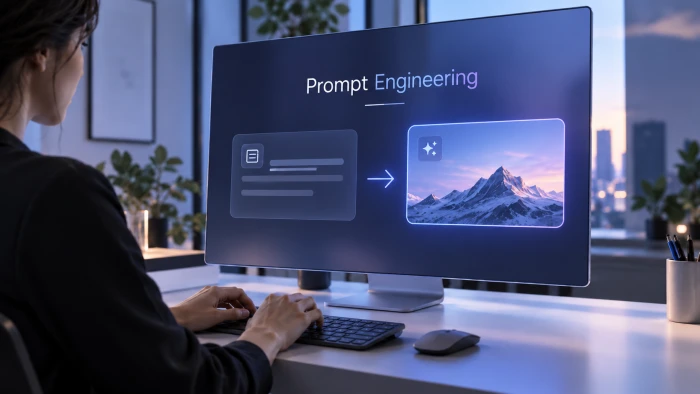
What prompt engineering meansPrompt engineering is the practice of writing clear instructions that guide an AI model toward the result you a...
Discussion
Join the discussion and share your thoughts below.
No comments yet. Be the first to share your thoughts!