
14 Best Gemini AI Photo Prompts for Girls and Boys in 2026
Scroll far enough through any Indian feed in 2026 and the same shot keeps reappearing in variations: a familiar face, unmistakably real, sta...
Text can describe a type of face. Only a stable reference and disciplined prompts keep it the same face across every image you make.

Consistency is measurement: lock the features that make a face recognizable, then change everything else.
Generative models rebuild an image from scratch each time. Without a fixed anchor, the model treats every prompt as a brand new person and decides the details itself.
Even strong identity systems can shift features across extreme poses, big style changes, hard lighting, or low-resolution faces. The goal is not perfection. It is to narrow how much the model is free to invent.
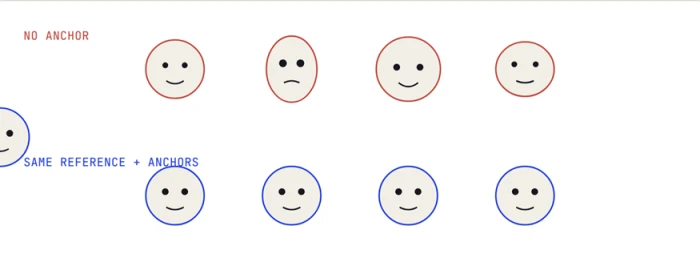
Left to right: same session, four generations. The top row invents a new person each time.
If you remember one technique, use a reference image. It gives the model the specific person instead of a category.
Pick a front-facing or three-quarter portrait in even lighting. Keep features unobstructed, high-resolution, and free of heavy filters or accessories.
• One clear face, neutral light, minimal makeup or glasses.
• High resolution so fine features stay readable.
• Reuse the same reference every session, not a slightly different photo each time.
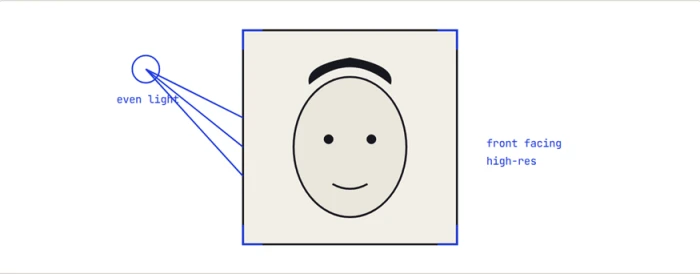
The reference is your anchor. Everything else in a scene is allowed to move.
The image shows the model what the face looks like. The prompt reminds it which traits to protect. You need both.
Keep a fixed block of facial anchors that never change, no matter the scene. Add identity wording like “same person” or “returning character” so the model treats each image as one continuous identity.
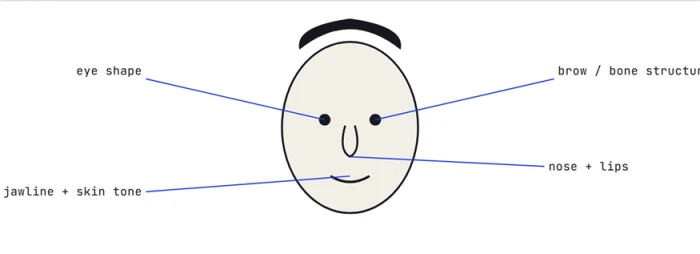
A reusable anchor block: face shape, eyes, nose, lips, jawline, skin tone, age, hair.
Add micro-detail on purpose. Asking for natural skin texture, visible pores, and subtle lines stops the model from smoothing your face into a generic ideal.
Separate the person from the scene. Keep the identity block stable and vary only the pose, outfit, background, or lighting.
Introduce big changes gradually. If you swap pose, hairstyle, age, lighting, and art style all at once, you lose the ability to see what caused the face to drift.
• Vary pose or outfit or location, one axis per test.
• Keep the strongest results and reuse them as new references.
• Watch style shifts closely, since they pull hardest on facial features.
Models like to reshape and smooth. Explicit negatives tell them not to.
• no facial reshaping
• no beauty filter
• no altering eye shape or skin texture
Being blunt about what must not change is often more effective than more description of what should.
Both follow the same shape: reference, fixed identity block, a firm preserve instruction, then only the scene changes.

Example A / new setting cafe lifestyle
Create a fresh modern lifestyle portrait using the uploaded adult woman’s photo while keeping her real facial identity, natural expression and authentic appearance unchanged. Place her in a bright white cafe terrace surrounded by soft green plants and a clean airy environment. Dress her in an elegant yet casual outfit such as a simple kurti with jeans or a lightweight linen ensemble. Capture a relaxed standing pose with one hand naturally near her hair, an effortless everyday fashion moment. Use soft daylight, gentle shadows, warm neutral colors, realistic skin details and natural surroundings. High-end lifestyle look for social media, vertical 4:5 composition. Avoid text, branding, watermarks, distorted hands, missing fingers, unnatural limbs or unrealistic facial changes.

Example B / big style change split portrait
Use the uploaded photo as the strict and only identity reference for a single adult woman. Maintain her exact facial identity: facial structure, proportions, skin tone, eye shape, nose, jawline, lips, hairline and hairstyle, with no reshaping or beautification. Ultra-realistic cinematic studio portrait, vertical 4:5, DSLR realism, natural skin texture and visible pores, shallow depth of field. One continuous face divided by a jagged torn-paper seam down the center: the left side in warm color as her confident public persona, the right side in black and white as a quiet, melancholic hidden side, same features on both halves. Black turtleneck, wavy hair, matte black background. Avoid any second person, duplicate face, face merging, distortion, plastic skin, cartoon or 3D-rendered appearance.
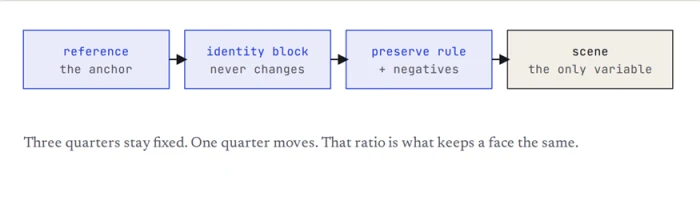
Anatomy of a consistency prompt.
Reference-based generation improves consistency but does not guarantee it. Generative AI is still generative.
For casual work, small variation is fine. For campaigns, recurring characters, or a real person’s likeness, inspect every final image against your reference rather than assuming it matched.
Consistency compounds. The more you reuse the same reference, the same anchor words, and the same camera standards, the more stable the face becomes over time.
• One clear reference photo, reused every time.
• A fixed identity block in every prompt.
• Identity wording: “same person”, “returning character”.
• Negatives against reshaping and filters.
• Change one variable per generation.
• Reuse your best output as the next reference.
• Review every final image.
A face stays the same when you stop starting over. Lock one reference, keep one identity block, change one thing at a time, and check every result. Consistency is not a setting you switch on. It is a habit that compounds: the more you reuse the same anchors, the steadier the face becomes.
Scroll far enough through any Indian feed in 2026 and the same shot keeps reappearing in variations: a familiar face, unmistakably real, sta...

Prompt writingBrief the model like a colleague. Read the reply. Done.Prompt engineeringBuild the prompt like a function. Inputs, outputs, te...

Scroll far enough through any feed in 2026 and the same handful of looks keep repeating. A colleague sealed inside collector toy packaging....
Discussion
Join the discussion and share your thoughts below.
No comments yet. Be the first to share your thoughts!